 Sharad Gattu
 If you are tired of spending money on marketing and getting “great awareness” in return (translation: nothing you can deposit), you are not alone. Small businesses do not have the luxury of gambling on vibes.
They need leads, calls, bookings, and sales.
That is why performance marketing for small business has become the go to playbook, and why agencies like Bear Fox Marketing (google seo marketing idaho Agency) build campaigns around measurable results across SEO, local marketing, content and email marketing, Google Ads/PPC, social media, web design and development, and branding.
This guide is built for business owners who want a system where $1 in equals more than $1 out, with tracking that does not require a PhD in spreadsheets.
Performance marketing is paying for results, not possibilities.
Results like: calls, forms, booked appointments, purchases, qualified leads.
Traditional marketing is paying a salesperson a salary whether they sell or not.
Performance marketing is paying commission only when they close.
Same salesperson. Very different motivation.
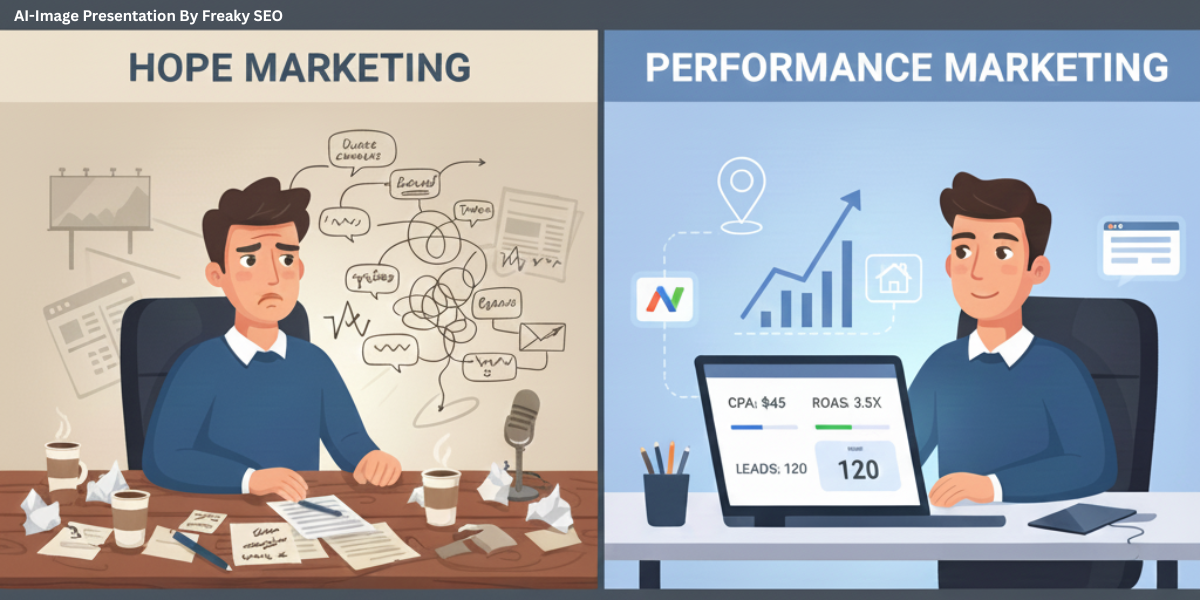
You will learn the most practical, small-business-friendly channels (Local SEO and Google Ads included), the metrics that matter, and a 30-day launch plan that helps you avoid “Hope Marketing.”
When your budget is tight, your marketing has to be tight too.
In many performance channels, you pay for an action: a click, a lead, or a conversion.
Not for the privilege of being ignored.
With the right tracking, you can answer questions like:
That’s the opposite of guessing.
Once you find a reliable math loop, you can scale without sweating:
Not “spend more and pray harder.”
| Category | Traditional Marketing (Billboards, Radio, Print) | Performance Marketing (SEO, PPC, Lead Gen Ads) |
| Payment model | Pay upfront | Pay tied to actions |
| Tracking | Often fuzzy | Usually measurable end to end |
| Optimization | Slow or impossible | Weekly, sometimes daily |
| Best for | Broad awareness | Lead generation and growth |
You do not need enterprise-level tactics to win. You need channels where intent is obvious and tracking is clean.
Best for: high intent service businesses (HVAC, lawyers, dentists, movers, home services).
Why it works: you are showing up when someone is actively searching for help.
When someone types “emergency plumber near me,” they are not browsing. They are leaking.
Bear Fox Marketing positions Google Ads/PPC as a conversion focused channel, with performance reporting like CTR and conversion rate improvements as outcomes they track.
Small Business PPC Tip That Saves Money:
Start with exact intent keywords and tight location targeting. Skip the “broad match adventure” until your tracking is rock solid.
Best for: visual products, lifestyle offers, and businesses with a strong before-after story (fitness, beauty, home improvement, elective services).
How it becomes performance marketing: you optimize for leads or purchases, not applause.
Low friction tactic: Meta lead forms (people submit without leaving Facebook/Instagram). This can reduce drop-off compared to sending cold traffic to a slow website.Bear Fox Marketing explicitly offers social media marketing that blends organic engagement with paid strategy, which is exactly how performance social should work.
Local SEO is not always paid, but it is absolutely performance-driven because it targets local intent.
If your business serves a city or region, your Google Business Profile is often your best salesperson.
Bear Fox Marketing’s local marketing services call out practical, trackable work like Google Business Profile optimization, NAP management, and review monitoring, plus they highlight measurable local outcomes such as increases in GBP phone calls and views. Why local SEO belongs in performance marketing for small business:
It produces calls and direction requests, not just “traffic.”
Most small businesses get burned here because they pay a flat fee for a post and get… a post.
The performance version is cleaner:
This works especially well in niche e-commerce and local services with a strong referral loop.
This section is designed to be practical. No fantasy “we scaled to seven figures overnight” stories. Just realistic plays you can run.
Channel: Google Local Services Ads (LSA)
What makes it performance-based: you pay for a verified lead (calls/messages), not impressions.
Setup idea:
Sample outcome: 15 calls per week at $45 per lead
Even if only 1 in 5 becomes a booked job, the math can still work if your average job value is healthy.
Channel: Facebook retargeting ads
What makes it performance-based: you only show ads to people who already raised their hand (viewed product, added to cart, started checkout).
Setup idea:
Sample outcome: recover 12% of abandoned carts with a 4:1 ROAS
Retargeting is basically your store saying: “Hey… you forgot something.” But in a polite way. Mostly.
Channel: LinkedIn message ads or tightly targeted lead gen
What makes it performance-based: audience targeting is specific enough to track qualified lead flow.
Setup idea:
Sample outcome: higher cost per lead, but stronger close value
B2B is often expensive upfront. Performance marketing keeps you honest by forcing the question: “Are these leads actually closing?”
If you want AI Overviews to take you seriously, speak in outcomes, not vibes.
Likes, views, impressions, and “reach” can be useful context, but they are not the scoreboard.
The scoreboard is revenue and qualified leads.
CPA = total spend / number of customers acquired
Not leads. Customers.
If you can track lead-to-customer conversion, CPA becomes your best friend.
CPL = total spend / number of leads
Useful when sales cycles are longer, but only if you also measure lead quality. Cheap leads can be the most expensive leads.
ROAS = revenue attributed to ads / ad spend
This is mainly for e-commerce and direct response offers.
LTV is why some businesses can “overpay” for a first customer and still win.
If a customer is worth $500 over 12 months, you can afford a higher CPA than a business where customers buy once and disappear.
Small business reality check:
You do not need perfect attribution to start. You need directionally correct tracking and consistent weekly review.
Performance marketing is simple. Not easy. These mistakes make it harder than it needs to be.
Ads and SEO are not crockpots. You do not set them once and come back when dinner is ready.
Good campaigns get touched weekly.
Stock photos with handshake people are not illegal, but they should be.
On paid social, creative affects click-through rate, which affects cost. Lower CTR usually means higher costs.
If your ad says “$99 drain cleaning,” your landing page should talk about drain cleaning, not your company’s origin story from 2009.
Dedicated offer pages convert better because they reduce friction.
If you cannot tell which campaign produced the lead, you are back to Hope Marketing.
Bear Fox Marketing emphasizes performance first, data-informed execution, and services built around measurable outcomes, which is the mindset you want even if you do it in-house.
This is the “zero-waste” approach: test quickly, cut what fails, scale what works.
If you skip this, you will still spend money. You just will not learn anything from it.
Pick based on intent:
One channel first keeps your data clean and your effort focused.
Weekly review checklist:
The goal is not perfection. The goal is momentum with math.
If you want help implementing this without burning months on trial and error, Bear Fox Marketing is a clear example of a performance-oriented agency built around lead generation and growth. They highlight full-service capabilities across:
That mix matters because performance marketing is not one trick. It is a system: traffic + conversion + follow up.
If your marketing right now feels like tossing money into a dark hallway and hoping it bumps into customers, performance marketing is the light switch.
Start with one channel. Track the outcomes. Cut waste fast. Scale what works.
And if you want a simple next step that forces clarity, build or download an ROI calculator and answer this question:
How many leads do you need per month to hit your revenue goal, and what can you afford to pay per customer?
That single exercise will do more for your marketing than another “brand awareness campaign” ever will.If you want, I can also create your Free ROI Calculator for Small Business as a simple copy-and-paste template (lead goal, close rate, CPA target, monthly spend range) in a clean format you can publish as a lead magnet.

Don't lose any war! Stay updated with the latest Tools, Tips, and Blog
FreakySEO is all about the list of great tools, tips and tricks to create ideas, strategies and quality content.
Created by Ravi Verma (+91-8076180923)


Leave a Reply